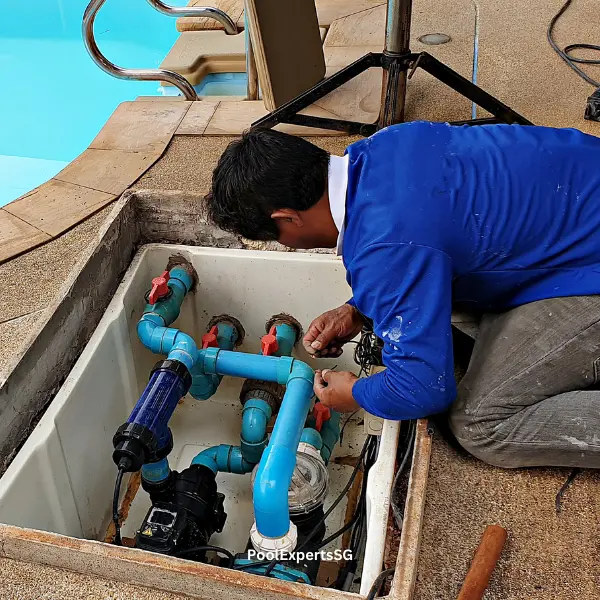
The pool pump is the heart of your pool system. It drives circulation, powers filtration, and moves water through any heating or treatment equipment. When the pump fails, everything downstream fails with it — water quality degrades fast, algae establishes quickly, and chemical treatment becomes ineffective.
Pool pump problems tend to announce themselves clearly if you know what to listen and look for. Here’s a guide to the most common issues, their causes, and what repair or replacement involves.
Common Pool Pump Problems
Pump Won’t Start
A pump that won’t turn on at all points to an electrical issue or a seized motor. Check the circuit breaker first — pool pumps draw significant current and will trip a breaker on overload. If the breaker is fine, the motor capacitor (which provides the startup torque) may have failed. Capacitor replacement is a straightforward repair. A seized motor from corrosion or debris ingestion typically requires motor replacement.
Loud Grinding or Screeching Noise
A grinding sound during operation indicates worn motor bearings. Bearings are consumables with a finite lifespan — in Singapore’s humid environment, corrosion accelerates bearing wear significantly. A screeching sound is usually the early stage; a grinding sound means the bearings are close to failure. Running a pump in this state will eventually seize the motor entirely.
Bearing replacement is possible on most pumps and is more cost-effective than full motor replacement if the motor is otherwise in good condition.
Humming But Not Spinning
A pump that hums but doesn’t rotate has power reaching the motor but something is preventing it from turning. Common causes:
- Failed capacitor
- Motor windings damaged by overheating
- Impeller jammed with debris
Turn off power before inspecting. A jammed impeller is often cleared by removing the pump lid and extracting the debris blocking the impeller housing.
Air Bubbles in the Return Jets
Bubbles returning to the pool from the jets indicate air is entering the system on the suction side. This reduces pump efficiency, causes the pump to cavitate (run partially dry), and can damage the seal over time.
Common entry points for air:
- Loose pump lid O-ring — the most common cause; the O-ring seal on the pump strainer basket lid dries out and cracks
- Cracked suction line fitting
- Low water level at the skimmer, allowing the skimmer to draw air
- Leaking valve union on the suction side
Lubricating or replacing the pump lid O-ring is a five-minute fix that resolves air in the system in most cases.
Low Flow and Pressure
Weak return flow with normal pump operation usually points to a blockage rather than a pump problem. Check in order:
- Skimmer basket — full baskets reduce suction significantly
- Pump strainer basket — should be clear
- Filter pressure — a clogged filter is the most common cause of flow reduction
- Partially closed valve on the suction or return line
If all of the above are clear and flow is still low, the impeller may be worn or cracked, reducing its ability to move water effectively.
A cascade or spout that runs weak can have the same cause. See pool water feature repair.
Pump Losing Prime
A pump loses prime when it can no longer maintain a full column of water on the suction side. Once a pump loses prime, it runs dry and overheats rapidly. This usually indicates an air leak on the suction side (see above) or a pump installed above the water level without an adequate priming arrangement.
Water Leaking from the Pump
Leaks from the front of the pump housing indicate a failed mechanical seal — the seal between the wet end (impeller housing) and the motor. Mechanical seals are wearing components that need periodic replacement. A leaking seal left unaddressed will allow water to enter the motor, causing winding failure and complete motor replacement. For leaks in other parts of the pool, see pool leak detection and repair.
Repair vs. Replacement
| Problem | Repair or Replace? |
|---|---|
| Failed capacitor | Repair — low cost, straightforward |
| Worn bearings (motor otherwise good) | Repair — bearing replacement |
| Cracked impeller | Repair — replace impeller |
| Failed mechanical seal | Repair — seal replacement |
| Burned motor windings | Replace motor or full pump |
| Pump >8–10 years old, multiple issues | Replace — new pump more cost-effective |
| Pump undersized for pool volume | Replace with correctly rated unit |
A Pool Experts SG technician will assess whether the motor is worth rebuilding or whether a new pump offers better long-term value. For pumps under five years old, repair is almost always the right call. For older pumps with multiple failing components, a new variable-speed pump will also deliver significant energy savings over a single-speed replacement.
Extending Pool Pump Life
- Keep baskets clean — A full skimmer or strainer basket forces the pump to work harder against reduced suction, increasing wear on bearings and impeller
- Maintain water level — Running the skimmer half-empty allows air ingestion
- Check the lid O-ring annually — Clean and lightly lubricate with silicone grease; replace if cracked or flattened
- Don’t run the pump dry — If you hear the pump working hard with no water moving, shut it down and investigate before restarting
- Service the pump area — Pump pits in Singapore accumulate moisture; ensure ventilation is adequate to slow corrosion
Signs You Need a Professional
Some pump issues are straightforward DIY — clearing a blocked basket, replacing an O-ring, resetting a tripped breaker. But these situations warrant a call to Pool Experts SG:
- Any electrical fault beyond a tripped breaker
- Grinding or screeching noise that persists
- Water leaking from the motor end
- Pump that repeatedly loses prime despite clear suction lines
- A pump that trips the breaker on startup (potential motor fault or wiring issue)
Related: Pool Filter Failure: Signs and Fixes | Pool Leak Detection in Singapore
Get Your Pump Diagnosed by a Professional
A pool pump that’s grinding, losing prime, or refusing to start isn’t going to get better on its own. Catching the problem early — a worn bearing, a failing seal, a blocked impeller — is almost always cheaper than waiting until the motor fails completely.
Pool Experts SG diagnoses and repairs pool pumps for residential and commercial properties across Singapore. We carry common replacement parts, so most repairs are completed on the first visit without the delay of ordering components. Where replacement makes more sense than repair, we’ll tell you honestly and help you select a correctly sized unit.
If your pump is showing any of the warning signs above, contact Pool Experts SG to book a pump inspection. We’ll assess it on site and give you a clear repair or replacement recommendation.
FAQs
How long do pool pumps last in Singapore?
A quality single-speed pool pump typically lasts 8–12 years with regular maintenance. Variable-speed pumps have more complex electronics but generally carry longer manufacturer warranties. Singapore’s humidity accelerates corrosion, so protecting the motor from moisture exposure extends lifespan.
Why is my pool pump so loud?
A pump that has become significantly louder than normal is almost always developing bearing wear. Address it early — bearing replacement is straightforward and affordable; a seized motor from failed bearings is not.
Can I run my pool without a pump for a few days?
You can, but water quality will degrade quickly without circulation. Chemical distribution becomes uneven, dead spots allow algae to establish, and the filter stops working entirely. For anything beyond 24 hours, manual treatment is needed to compensate.
How much does pool pump repair cost in Singapore?
Capacitor replacement: $80–$150. Bearing replacement: $150–$300. Mechanical seal replacement: $120–$200. Full motor replacement: $300–$600 depending on motor rating. New complete pump unit: $400–$1,500 depending on flow rate and type.
Is it worth repairing an old pump?
If the repair cost is more than 50% of a new equivalent pump, replacement is usually the better investment — particularly if the pump is more than seven years old. A new variable-speed pump will also significantly reduce running costs compared to a worn single-speed unit.